A balancing act

As crazy as it is for me to believe, I am now over halfway through my time in Lisbon. My experiences thus far have been amazing– the people here continue to be extremely welcoming, the pastries and coffee never fail me, and I’m always in awe of the intricately-patterned tiles and street art that you can find all over the city. I’ve also had some amazing opportunities to travel in the past month, visiting both São Miguel Island (in the Azores) and Amsterdam. São Miguel was one of the most naturally stunning places I’ve ever seen, and the architecture and canal system in Amsterdam make it a truly enchanting city. I feel extremely blessed to have the opportunity to travel and experience all sorts of different cultures while I am here in Europe.

This slideshow requires JavaScript.

Even though the weather wasn’t very cooperative, the natural beauty of São Miguel still managed to shine through all weekend.

This slideshow requires JavaScript.

The unique architecture, canals, and bikes make Amsterdam feel like a very quaint city (and also make it pretty photogenic). Amsterdam is also already prepared for the holidays with string lights and decorations throughout the city.

But, since my role in this blog is to give a realistic and practical depiction of my experience, I must admit that studying abroad is not only delicious food and weekend trips. Traveling and exploring and learning about new places is certainly awesome, but there are definitely some parts that are not so great.

For instance, trying to pick courses for next semester without actually being able to talk to any of my advisors is very stressful. Yes, I can email them, but it can be very difficult to get a prompt response during this hectic time of the year. As someone who becomes stressed fairly easily, I’ve had to try to stay calm and have simply had to do my best with the guidelines online. And most of all, I have to remind myself that there is no point in stressing out– everything will be okay.

And speaking of stressing out, one of the biggest burdens for me right now is the amount of writing I need to do in the next month. Up until this point, I have always had the experience of the American education system, where assignments tend to be spread out over the course of the semester, but that simply is not the case here. While I have readings nearly every day for my classes, I have not had any graded work all semester. This may seem like a good thing, but that also means that I have no gauge of how I am doing in any of my classes and my grades are all dependent on the writing assignments, oral presentations, and exams that I have in the next month. Some people may love this system, but I’m really not used to it and am feeling a lot of pressure. Not to mention that there is no such thing as a grade curve here and it’s not unusual for the average grade to be a 60.

(I don’t say this to scare you if you have plans of studying abroad in the future– this is not the experience that most people have. The reason that I have all of this work is because I am taking direct enrollment classes to fulfill my major requirements at home, and not just the courses that my program offers.)

But most of all, I’m at a point where I’m really missing my family and friends. In fact, this is the longest amount of time that I’ve ever been away from my family. I’ve made friends and met some great people here, but as the holidays are coming up, it is difficult for me to be away from home and the traditions that I have there. Thanksgiving is one of my favorite holidays, but, for obvious reasons, it is not a holiday here at all. Thankfully, however, my program is hosting a Thanksgiving dinner for us since they know that it is an integral part of our culture at home. It may be different than my traditional holiday experience, but I definitely feel lucky to be a part of a program that is allowing us to celebrate a holiday that doesn’t exist here but is important to us.

Despite these stressors, however, I’m trying my very best to savor my time here. I know in a few short months I’ll want nothing more than to return to Lisbon and I cannot wish away the time now. So even on days where I have to settle in and work diligently on papers, I make sure to do them at a cafe where I can enjoy the delicious treats of the city. I also make sure to walk to that cafe to take in the sights of the city that give it its unique personality. And, of course, I remind myself that even though it may be difficult, my education is a privilege and I must do what I can to make the most of it.

On days where I miss my family and friends, I try to call and text them to tell them about my great experiences and to hear about theirs as well. This is really helpful because it allows me to share my time here with them, even if they cannot physically be here, and allows me find out what’s going on at home, even if I cannot physically be there.

But most importantly, I remind myself to take this experience one day at a time. I cannot change the past or the future, so I must just do what I can to make the best of today. And today, I am in a beautiful city, speaking a language that I’ve been trying to master for years, and learning about a culture that I always knew through my dad, but never got to experience first-hand. I’m doing something that I’ve wanted to do ever since I knew what studying abroad was. I’m living a dream.

So yeah, it’s not always easy and it certainly isn’t always perfect, but it sure is worth it.

 

A weekend in Rome

One of the many beauties of studying abroad in Lisbon is how convenient it is to travel to other parts of the continent. This past weekend, for instance, I took advantage of this opportunity and spent three days in Rome with my sister, Chris, and my new brother-in-law, Rob. (Yes, I may have crashed their European honeymoon, but I promise I was invited.)

I’m sure you’ve heard about all the amazing things that happen when you’re able to travel internationally with ease, but since I’m supposed to be writing a practical guide, I have to tell you that things are not always as effortless as they seem. Here’s the proof in the pudding:

While planning to go to Rome for the weekend, I actually really only had to book a flight and pack my clothes– Chris and Rob took care of the Airbnb and planning the sightseeing. But this sweet simplicity soon changed the around midnight the night before I left, when the power at my apartment in Lisbon went out just hours before I had to be at the airport.

I hadn’t quite finished packing, my phone was not charged, and I was really hoping to get a quick nap in before my 5am departure from my residence, but I was committed to making the best of the situation. So I plugged my phone into my laptop to charge, gave myself a few extra minutes to get ready when setting my alarm, and put my head down to sleep. Needless to say, between my excitement about seeing Chris, Rob, and a new city, and worries about the power outage, I really didn’t sleep much at all. And actually, when my alarm went off at 4:15, the power was still out. But still set on having a great weekend, I got ready in the dark, met my friend, Casey, in the stairwell (she also was going to visit a friend in Rome), and hopped in an Uber to get to the airport.

**A quick note on my experience with Portuguese airlines: they are notoriously unreliable. Their flights are almost guaranteed to be delayed, their luggage policy is strict, their communication is horrendous, but their employees are quite amiable and despite their flaws, I will continue to be a loyal customer.**

Naturally, the airline had the wrong terminal listed online, so when Casey and I got to the airport, we quickly realized we were in the wrong place. Conveniently, things like this must happen pretty often because there is a terminal-terminal shuttle that runs every 10 minutes, even at 5am. So, after a morning of chaos, we made it to the gate in time to board as the very last passengers on the flight.

And actually, my luck started to change when I got on the plane and found out that I had a row to myself in business class, even though I had only paid for economy. That was the first time that had ever happened to me, so I was incredibly excited and decided that the day was now looking up. Despite a missed train on our way from the Rome airport to the city center and some difficulties actually finding Chris and Rob, the day really did start improving.

IMG_1225

Even from the sky, I was already stunned by Italy’s beauty.

On our way from the train station to the Airbnb, we stopped at the Colosseum, looked at some ancient ruins,  and bought some supplì for a delicious lunch. Throughout the weekend, I was able to see some stunning sights including Saint Peter’s Basilica, the Pantheon, the Trevi Fountain, the Spanish Steps, the Borghese Gardens, and many ruins and beautiful piazzas. I also ate some amazing food– everything from the cornetti, to the many pastas, to the pizza with fresh mozzarella, to the fruit from the market, to the cappuccini– and it was a really good thing that we walked 10 miles each day to work it all off. As my sister pointed out many times, it was probably the best weekend food-wise of my life. And on top of it all, spending time with Chris and Rob made my heart full after nearly two months without seeing my family and friends from home.

IMG_1331

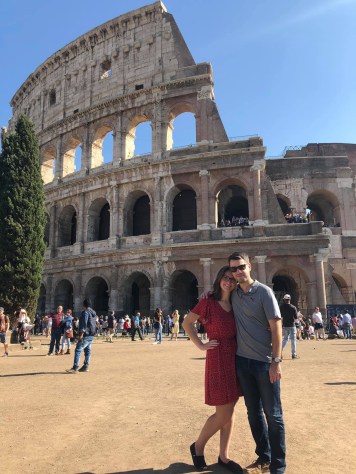
Chris and Rob secretly loved having me as a personal photographer because they aren’t used to being able to take pictures together when they travel. Here they are at the Colosseum.

It truly was a wonderful weekend. Seeing things that I had read about in history books and looked at in travel books was honestly surreal. I’m still struggling to wrap my head around how ancient structures are still standing and how I was fortunate enough to visit a city with so much history. Many of the paintings and statues that I saw (especially in the basilica and the Pantheon) were pieces that I had learned about in history classes and never expected to really see in person. To me, traveling to a place like that makes you realize how big the world really is and how much more to life there is beyond your small world. It really is eye-opening.

IMG_1329

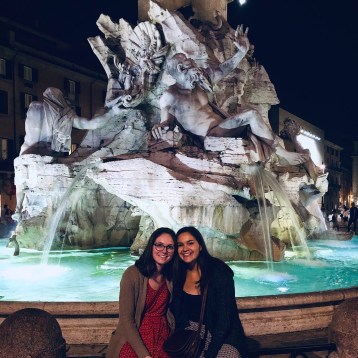
Chris and I made sure to take lots of pictures to send to our parents and our older sister, Beth. Here we are in front of a fountain at one of the piazzas before eating a delicious dinner.

But as happy as I was while in Rome, I knew that I had to get back to Lisbon and get some homework done after a weekend of neglecting the readings and assignments I still had to complete. When Sunday evening came around, I certainly was sad to leave my sister and brother-in-law and such a beautiful city, but I also felt a sense of relief that I would be able to return to Portugal and get back on track before I started to fall behind in my schoolwork.

Around 5:30 on Sunday evening, I left Chris and Rob and went to the train station so I could get back to the airport. And I’m not sure if you’ve noticed this trend yet, but I tend to have bad luck when it comes to the travel part of traveling. So of course, as soon as I got to the train station, I watched the police close off the hallway where tickets to the airport were sold. Knowing an extremely limited amount of Italian, I was nervous to ask for help, and instead tried to figure out an alternative, like using a machine instead of a kiosk, but to no avail. I even looked up how much an Uber would be, but I definitely didn’t want to spend 75 euros on a 30-minute car ride. Eventually, I swallowed my pride and, in a very broken mix of Italian and English, asked a security guard what I should do. Naturally, the answer was right in front of me the whole time– I was simply using the wrong machine. But anyways, I got on a train and made it back to the airport in time for my flight.

And oh boy, did I end up having enough time. My scheduled boarding time was 7:30 pm, but when I got to the gate, I was told that it would be delayed about a half hour. Then, around 8:00, I was told that the gate had changed. Then, I was told that the flight was delayed until 9:30, then 10:30, then 11:00, then 12:30, and finally 1:30. (We ended up actually leaving around 2:00.) Luckily, I had my laptop with me, and all of this extra time gave me a chance to do some readings for one of my classes and begin to reorganize. Unluckily, this six hour delay meant that I did not return to Lisbon until 4:00am local time (still in desperate need of a shower) and I had class at 9:00am.

I really do value my education, but I decided to skip that class in favor of catching up on sleep and getting some assignments done for the week ahead. It wasn’t exactly ideal, and truthfully, I was still exhausted after sleeping in, but I can tell you that there is no part of me that regrets my trip.

That’s the thing about studying abroad: it certainly is about studying, but it’s also about your experiences. In 20 years, am I going to remember missing class after returning from Italy? Nope. Am I going to remember seeing all of the amazing food and sights and crashing my sister’s honeymoon? Absolutely. Am I going to remember all of the traveling mishaps? Unlikely. So in the end, it’s worth it. Traveling isn’t as perfect as people make it out to be, but by all means, you should still do it when you have the chance, even if it means putting in a little extra effort.

Get out there, get out of your comfort zone, and see what else the world has to offer. You won’t regret it.

IMG_1328

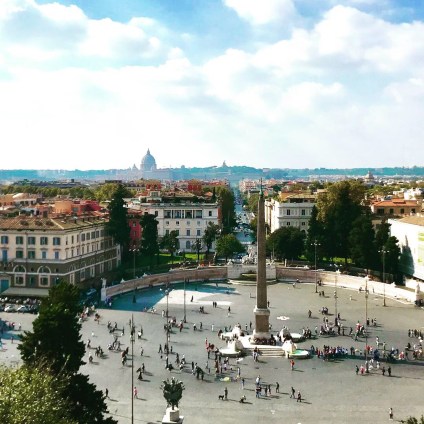
This view, near the Borghese Gardens, was my favorite of the city. If you look closely, you can see Saint Peter’s Basilica in the background.

Settling in

After being in Lisbon for five weeks, I can now say that I no longer feel like a glorified tourist, exploring the city and culture for a while longer than the average outsider. My days are not filled with sightseeing, but instead with classes, readings at coffeeshops, and spending time with new friends. I know where to find the cheapest high-quality expressos, I use my memory instead of GoogleMaps to get to my classes, and I can even tell you which buses to avoid if you want to get home with a semblance of personal space. I know which grocery stores to go on days when I need a piece of home, and, unfortunately, I’m well-acquainted with the Apple repair system in Lisbon after my laptop stopping working completely during the second week of classes. I am no longer a visitor; I am a resident.

That’s not to say I know everything about the city or its people– I have barely scratched the surface there, and I still have so much to learn– but I finally feel like I’ve settled in.

Starting classes has definitely helped with that process, adding structure to my day and reminding me that I’m still a student, even if I’m on a different continent. Studying here, however, is definitely very different than at UMass. For one, the program that I am in here, Study in Portugal Network, allows us to take classes at four universities: University of Lisbon, Portuguese Catholic University, Nova University, and ISCTE. (That’s not how a typical Portuguese university works– just my program.) Personally, I take five classes at three universities on four different campuses. So yeah, it’s a bit confusing at first.

But in addition to putting my navigation skills to the test, the education system in Lisbon is going to require me to be organized with my time. In the United States, most of my classes have assignments and readings over the course of the semester, with culminating exams and projects at the middle and end of the semester. Here, I have to do readings so that I can participate in class, but aside from my Portuguese language class, I do not really have many small assignments. To make up for that, however, I have already been assigned 125 pages worth of writing for the end of the semester. So unlike at home, I will not be able to leave my big papers to the last few weeks of school and, instead, need to start writing really soon. Honestly, I still haven’t really figured out how I’m going to get everything done, but I’m going to try to make a plan and stick with it so I’m not entirely overwhelmed when December arrives.

On the bright side, the lack of short-term assignments has given me more flexibility to travel. Two weeks ago, for instance, I was able to go north to the cities of Aljubarrota, Arouca, and Porto with my program. In Aljubarrota, we learned about the famous battle in which the vastly outnumbered Portuguese army fought off the Castilians, in Arouca, we did an eight kilometer hike at the Passadiços do Paiva, and in Porto, we explored the city with a local guide.


The beautiful views in Arouca made it well-worth the four hour hike.
Every Portuguese city that I’ve visited is breathtaking, and Porto was no exception. On the left is a partial view from the Luiz I Bridge. On the left, my new friends and I have our backs to the river and the neighboring city of Gaia.

Then, last weekend, I went to the town of Óbidos with my visiting host family to go to a birthday party for their family friends. It was a great way for me to meet new people, practice my Portuguese, eat an abundant amount of delicious foods, and simply see a new place. Óbidos is a medieval villa with completely different architecture than I had been exposed to in other cities here and the view from the mountain top was incredible. The streets were also filled with performers, making the walk around the town even more entertaining. This was also the first time I was able to spend a full day with my host family and I really enjoyed getting to know them and appreciated them showing me around and being flexible with switching back and forth between Portuguese and English for my sake.

It is thanks to people like them that Lisbon now is starting to feel like a home to me, and I cannot thank them enough. This first month has been incredible and I can’t wait to see what the next three months have in store!

IMG_1182

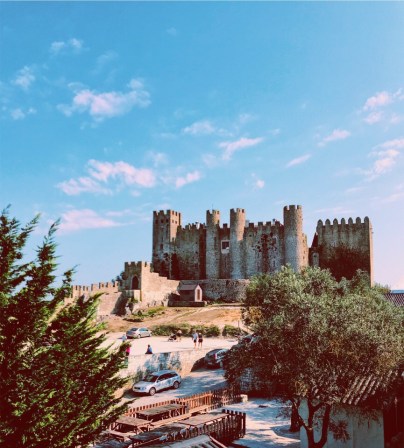
Here is the medieval Castle of Óbidos, which has been controlled by the Romans, the Moors, and the Portuguese, all contributing to its unique architecture.


On preconceptions, promptness, and praxe:

After two weeks of an unexpected vacation (more or less), occupying my time by finding beautiful beaches, quaint cafes, and unbelievable architecture in Lisbon, I finally began classes this week. Anxious that my previous education in the United States would not match up correctly with the European system, I started this week nervous wreck. What if I didn’t actually have the prerequisites that I thought I had? What if the professor called on me on the first day? What if everyone knew that I was not from here?

Well, some of these concerns were valid– I definitely don’t have the same knowledge coming in as some other students, the professor did call on me on the first day, and without the Hogwarts-esque garb that students in Lisbon wear on certain days, it is blatantly obvious that I’m not from here.

(See here for reference: Traditional Portuguese Academic Outfit)

But at the same time, I realized that none of those concerns are actually problems at all. My classes have been filled with a mix of Portuguese and other Erasmus students (students from other countries in the European Union) and my professors seem to be excited that we can bring different perspectives to the classroom. They also acknowledge that ALL of us come from different educational systems and are conducting reviews to try to level out the playing field before they start new material. When my professor called on me, he simply wanted to know where I was from and what subjects I have previous experience with so that he can tailor his lectures to the needs of our class. And finally, I am not envious in the slightest of the cloaks that the students from Lisbon are wearing as it has been nearly 90 degrees every day that I have been here.

There are other differences in classes here that I did not foresee, as well. For instance, classes pretty much universally start ten minutes after their assigned start time so if you arrive on time, you may be rather perplexed to walk into an empty classroom– don’t worry, the other students will, in fact, roll in after a few minutes. But besides this seemingly odd cultural norm, Portuguese students generally treat their education with much more respect than American students. While the majority of students in the United States would walk into an 8:00 a.m. class dressed in sweats with a coffee (and maybe even breakfast) in hand, Portuguese students seem to come to class straight off the runway, regardless of the time of day. Students never bring food or drinks, besides water, into class even though there are cafeterias in nearly every academic building.

Although all of these aforementioned differences require a little bit of adjustment for me, none of these things are particularly problematic. There is, however, a tradition at Portuguese universities that I am still not quite accustomed to called a praxe.

Before I start to explain this tradition, I want to acknowledge that I do not understand it entirely and that it is possible that some of what I know about it may have gotten lost in translation during a conversation between my program coordinator and myself. I did, however, try to do some research online to double-check my understanding so I believe that it is fairly accurate.

But anyways, the term praxe refers to the initiation rituals that occur on numerous university campuses in Portugal. It is a tradition that began in the 14th century with the intention of initiating first-year students by encouraging the loss of social inhibition. Older students traditionally play jokes on younger students and put them in strange situations, such as having them walk through the streets with cans on their feet. However, the praxe that I personally have witnessed so far is more of what would be considered hazing in the United States. And the strangest part, to me, is that it happens in  broad daylight, in the middle of the day, on campus, while students are supposed to be in classes. My classes are often punctuated by yelling outside as older students watch face-painted freshman run sprints, do pushups, et cetera. When I asked my program coordinator why students do this, she said that at many universities, students will be outcasted if they do not participate and will experience excessive discrimination in both their academic and social life. And it’s not even to join a club or a sports team– this is simply to be accepted by upperclassmen in their major.

Understandably, there is a large contingency of individuals who want to abolish this tradition, mostly because there have been incidents that have gotten out of hand, resulting in injury and even death. Many others however, argue that praxe is a tradition and it helps students to maintain respect for their education. So I guess we’ll see what happens in the coming years, but for now, I’ll just say that I’m glad that I’m not the one going through it.

And on a happier note, I’ll leave you with an assortment of pictures that I’ve taken in the past few weeks to inspire you to come visit Lisbon yourself. Enjoy!

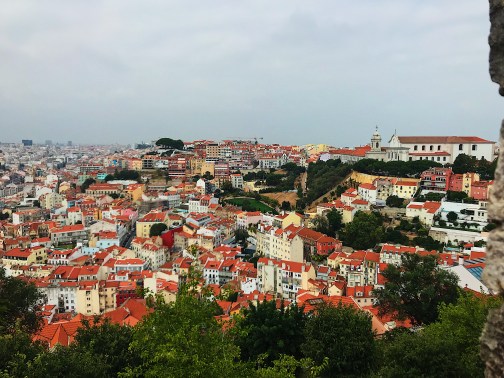
2FBF7FF0-C743-446E-BB64-68CFAC7A4443

View from lookout near São Jorge Castle– be ready to walk to get a view like this.

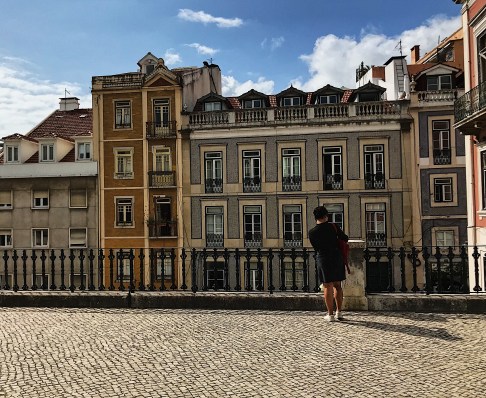
8A08B6B7-AA2E-4A8C-808C-9DED2E7D1CDF

Typical example of tiling on buildings in Lisbon (This one happens to be in a neighborhood called Rato.)

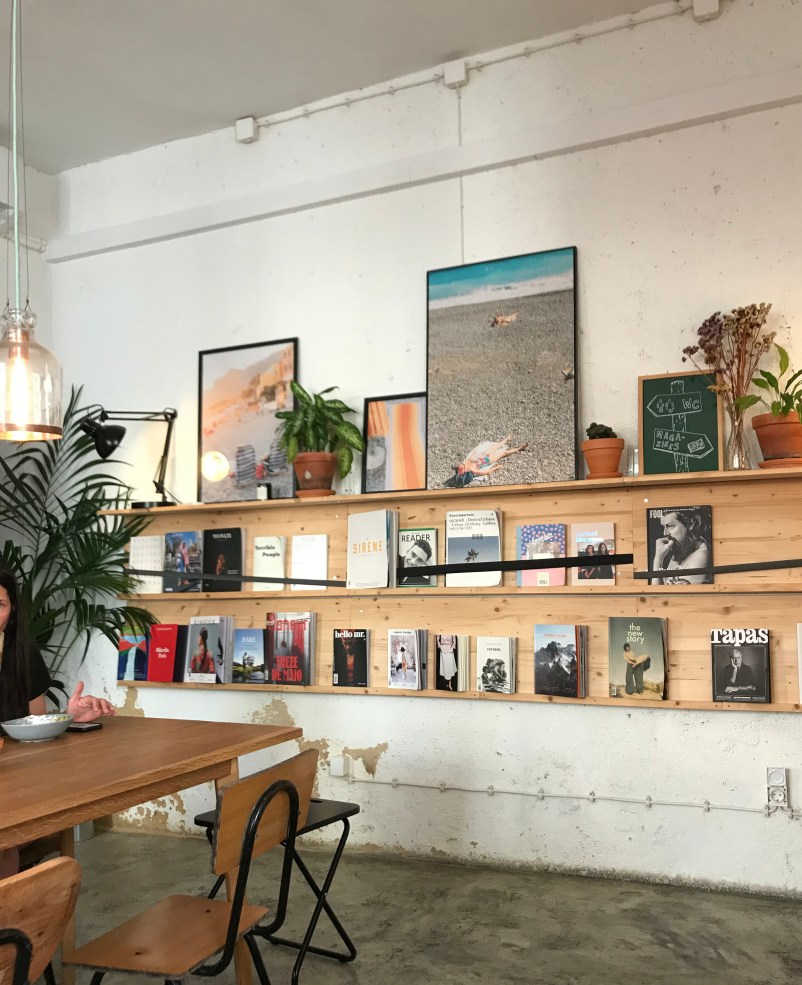
img_0951.jpeg

Lisbon has some of my favorite coffee shops and breakfast places. At this one, Hello Kristof,  they provide magazines to read as you wait for your order.

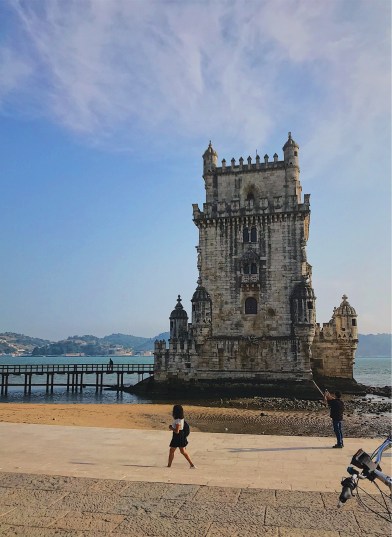
IMG_0972

A Torre de Belém was the last stop on our bike tour of the city. It was originally built in 1514 as a part of the defense system at the mouth of the Tagus River.

P.S. I failed to previously mention that I still have two more courses (History of Portuguese Expansion and Portuguese Language for Foreigners) that start next week, which will both be entirely in Portuguese. And needless to say, despite my good experiences thus far at Lisbon’s universities, I’m extremely nervous. This is my time to really put my Portuguese to the test– wish me luck!

My first days

Excited. Scared. Eager. Exhausted. Overwhelmed.

I have wanted to study abroad in Portugal ever since I knew what studying abroad meant. I’ve wanted to explore new places, eat delicious foods, practice my Portuguese language skills in a place it really counts, and learn about a culture that I always knew through my immigrant father and grandparents, but never really got to experience first-hand. I’ve wanted the freedom to learn in a city where no one knows me and I get to start fresh. I’ve wanted it all.

So naturally, now that the time has come for me to study abroad, I’m realizing that there’s a lot more to it than all of those amazing things I’ve longed for since I was a child.

Yes, I am absolutely loving walking around the city and looking at the beautiful buildings and tilework. I am loving meeting new people, drinking copious amounts of rich coffee, finding decadent new pastries, and exploring a place I’ve never really spent time in before. These parts are truly wonderful.

However…

Fighting with the Portuguese consulate to get my paperwork to leave? Not too fun. Finding out they filed the paperwork for the wrong type of visa? Mildly irritating. Not receiving my visa until the very morning I left for Portugal? Extremely stressful. Jet lag causing me to have no perception of time? Confusing. Missing my friends and family back home? Isolating. Dropping a carton of eggs on the ground because I didn’t realize it was perforated? Embarrassing. Trying to coordinate a class schedule that includes two languages, four universities, and multiple campuses? Overwhelming.

And yet, I know that where I am right now, is exactly where I am supposed to be. Studying abroad is about learning and growth and the complications and mixed emotions about being in a foreign city are all a part of that process. In order for me to experience all the good things, I have to work through the tough parts too.

So stay tuned because this journey will have its ups and downs and I’m sure I’ll have plenty of stories to tell, and I appreciate having you along for the ride.

Tchauzinho!