
After two weeks of an unexpected vacation (more or less), occupying my time by finding beautiful beaches, quaint cafes, and unbelievable architecture in Lisbon, I finally began classes this week. Anxious that my previous education in the United States would not match up correctly with the European system, I started this week nervous wreck. What if I didn’t actually have the prerequisites that I thought I had? What if the professor called on me on the first day? What if everyone knew that I was not from here?
Well, some of these concerns were valid– I definitely don’t have the same knowledge coming in as some other students, the professor did call on me on the first day, and without the Hogwarts-esque garb that students in Lisbon wear on certain days, it is blatantly obvious that I’m not from here.
(See here for reference: Traditional Portuguese Academic Outfit)
But at the same time, I realized that none of those concerns are actually problems at all. My classes have been filled with a mix of Portuguese and other Erasmus students (students from other countries in the European Union) and my professors seem to be excited that we can bring different perspectives to the classroom. They also acknowledge that ALL of us come from different educational systems and are conducting reviews to try to level out the playing field before they start new material. When my professor called on me, he simply wanted to know where I was from and what subjects I have previous experience with so that he can tailor his lectures to the needs of our class. And finally, I am not envious in the slightest of the cloaks that the students from Lisbon are wearing as it has been nearly 90 degrees every day that I have been here.
There are other differences in classes here that I did not foresee, as well. For instance, classes pretty much universally start ten minutes after their assigned start time so if you arrive on time, you may be rather perplexed to walk into an empty classroom– don’t worry, the other students will, in fact, roll in after a few minutes. But besides this seemingly odd cultural norm, Portuguese students generally treat their education with much more respect than American students. While the majority of students in the United States would walk into an 8:00 a.m. class dressed in sweats with a coffee (and maybe even breakfast) in hand, Portuguese students seem to come to class straight off the runway, regardless of the time of day. Students never bring food or drinks, besides water, into class even though there are cafeterias in nearly every academic building.
Although all of these aforementioned differences require a little bit of adjustment for me, none of these things are particularly problematic. There is, however, a tradition at Portuguese universities that I am still not quite accustomed to called a praxe.
Before I start to explain this tradition, I want to acknowledge that I do not understand it entirely and that it is possible that some of what I know about it may have gotten lost in translation during a conversation between my program coordinator and myself. I did, however, try to do some research online to double-check my understanding so I believe that it is fairly accurate.
But anyways, the term praxe refers to the initiation rituals that occur on numerous university campuses in Portugal. It is a tradition that began in the 14th century with the intention of initiating first-year students by encouraging the loss of social inhibition. Older students traditionally play jokes on younger students and put them in strange situations, such as having them walk through the streets with cans on their feet. However, the praxe that I personally have witnessed so far is more of what would be considered hazing in the United States. And the strangest part, to me, is that it happens in broad daylight, in the middle of the day, on campus, while students are supposed to be in classes. My classes are often punctuated by yelling outside as older students watch face-painted freshman run sprints, do pushups, et cetera. When I asked my program coordinator why students do this, she said that at many universities, students will be outcasted if they do not participate and will experience excessive discrimination in both their academic and social life. And it’s not even to join a club or a sports team– this is simply to be accepted by upperclassmen in their major.
Understandably, there is a large contingency of individuals who want to abolish this tradition, mostly because there have been incidents that have gotten out of hand, resulting in injury and even death. Many others however, argue that praxe is a tradition and it helps students to maintain respect for their education. So I guess we’ll see what happens in the coming years, but for now, I’ll just say that I’m glad that I’m not the one going through it.
And on a happier note, I’ll leave you with an assortment of pictures that I’ve taken in the past few weeks to inspire you to come visit Lisbon yourself. Enjoy!
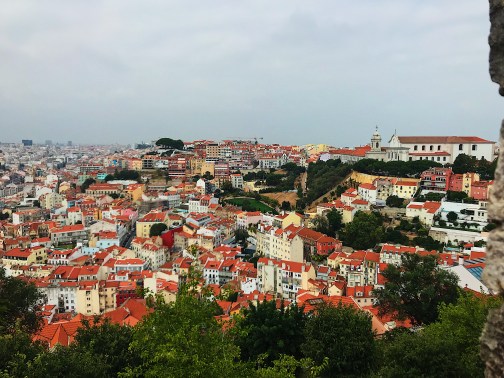
View from lookout near São Jorge Castle– be ready to walk to get a view like this.
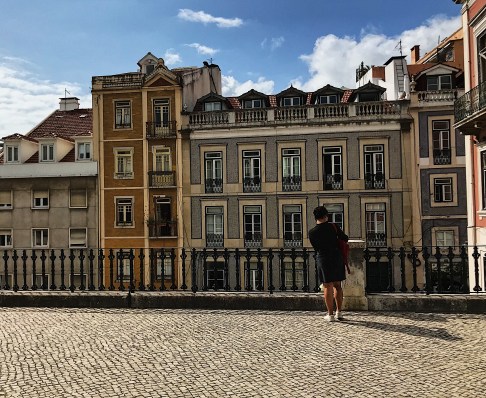
Typical example of tiling on buildings in Lisbon (This one happens to be in a neighborhood called Rato.)

Lisbon has some of my favorite coffee shops and breakfast places. At this one, Hello Kristof, they provide magazines to read as you wait for your order.

A Torre de Belém was the last stop on our bike tour of the city. It was originally built in 1514 as a part of the defense system at the mouth of the Tagus River.
P.S. I failed to previously mention that I still have two more courses (History of Portuguese Expansion and Portuguese Language for Foreigners) that start next week, which will both be entirely in Portuguese. And needless to say, despite my good experiences thus far at Lisbon’s universities, I’m extremely nervous. This is my time to really put my Portuguese to the test– wish me luck!
 Living and Learning in Lisbon